

Key Takeaways
- Gravel costs more upfront but needs almost no ongoing maintenance and lasts indefinitely.
- Organic mulch is affordable and improves soil, but requires replenishment every one to two years.
- Living ground covers take longer to establish but reduce long-term labor once fully grown in.
- Climate and soil drainage should drive your material choice as much as budget does.
- Combining materials in different yard zones often gives the best balance of cost and upkeep.
Our Verdict
No single ground cover works well in every yard. Gravel suits low-traffic, dry, or high-visibility areas where permanence matters. Mulch fits planting beds where soil health and affordability are priorities. Living ground covers reward patience with dense, self-maintaining coverage, especially in shaded or sloped areas. Most families get the most out of using two or all three across different zones.
| Best for | Recommended |
|---|---|
| Families who want a one-time install with minimal yearly upkeep | Gravel |
| Gardeners focused on soil health and keeping initial costs low | Organic mulch |
| Households with shaded slopes or areas where turf grass struggles | Living ground cover |
| Families on a tight budget covering large open areas | Organic mulch |
What each material actually does for your yard
Ground cover is any material that occupies bare soil, prevents erosion, and suppresses weeds. The three main categories work in very different ways.
Gravel (including pea gravel, crushed stone, and decomposed granite) is an inorganic material. It does not break down, does not feed the soil, and does not move unless disturbed. It reflects heat, drains quickly, and provides a permanent surface that needs little attention after installation.
Organic mulch (wood chips, shredded bark, straw, or pine needles) breaks down over time, slowly adding organic matter to the soil beneath. That decomposition is both the main benefit and the main drawback: it builds healthier soil, but the mulch itself disappears and needs topping up regularly.
Living ground covers are low-growing plants, such as creeping thyme, clover, ajuga, or ivy, that spread to fill open soil. They are the most biologically active option, supporting pollinators and improving soil structure. Getting them established takes a season or two, but a healthy mat requires little intervention afterward.
Each approach changes how you spend time and money, not just how your yard looks. See our guide to common lawn care mistakes for context on why bare soil is rarely a neutral choice.
Cost and installation compared
Material costs vary widely by region and supplier, but general ranges give a useful starting point for budgeting.
Gravel typically costs more per square foot than mulch at the time of purchase, and installation often requires landscape fabric, edging, and delivery fees for bulk orders. A 100-square-foot area can run anywhere from $100 to $300 depending on stone type and depth. However, gravel does not need to be replaced, so the lifetime cost is often lower than alternatives.
Bagged mulch runs roughly $3 to $7 per 2-cubic-foot bag at most home improvement stores. Bulk mulch delivered by the cubic yard is less expensive per unit, making it the more economical path for larger areas. A 100-square-foot bed covered at a 3-inch depth needs about 2.5 cubic yards. That said, annual or biannual replenishment adds up over time.
Living ground covers involve plant or seed costs plus soil preparation. Plugs or flats of plants cost more than mulch per square foot to install, and you may need to water and weed actively during the first growing season. Once established, ongoing costs are minimal.
| Gravel | Organic mulch | Living ground cover | |
|---|---|---|---|
| Typical upfront cost (100 sq ft) | $100 to $300 | $30 to $80 bulk | $50 to $150 in plugs |
| Lifespan | Indefinite | 1 to 2 years per application | Permanent once established |
| Ongoing maintenance | Very low | Annual topping up required | Low after year two |
| Weed suppression | Good with fabric base | Good at 3-inch depth | Good once fully established |
| Soil health benefit | None | Adds organic matter | Improves structure and biology |
| Best climate fit | Dry, well-drained areas | Most climates | Varies by species |
| Heat tolerance | Absorbs and radiates heat | Insulates soil | Depends on species |
For families weighing these costs in the context of a larger yard project, our comparison of raised beds and in-ground planting covers related budget trade-offs.
Maintenance demands over time
Gravel is the most hands-off option once installed. Weeds can still germinate in wind-deposited soil that settles between stones, so occasional spot-weeding or a pre-emergent herbicide application may be needed. Gravel can also shift on slopes and may need raking back into place after heavy rain.
Mulch requires the most consistent calendar commitment. A layer less than 2 inches thick loses much of its weed-suppression benefit, so checking depth each spring and adding material is a practical annual task. Mulch piled against plant stems can cause rot, so it needs to be pulled back a few inches from trunks and crowns.
Living ground covers demand the most work in years one and two. Irrigation, occasional fertilization, and pulling competing weeds before the ground cover fills in are all necessary. After that, most varieties require only light trimming once or twice a year to keep edges tidy. Some species, such as English ivy, can become invasive in certain climates, so local plant lists are worth checking before choosing a variety.
Pairing any of these materials with good irrigation planning reduces both water waste and maintenance time. Our guide to efficient garden irrigation covers how to match watering methods to different ground cover types.
Climate and soil considerations
Gravel performs well in hot, dry climates where it helps shed water quickly. In humid or clay-heavy soils, however, gravel can trap moisture and create drainage problems if the base is not prepared correctly. It also absorbs and radiates heat, which can stress nearby plants in full-sun Southern or Southwestern yards during peak summer.
Organic mulch is well suited to most climates and moderates soil temperature in both directions, keeping roots cooler in summer and warmer in early spring. In very wet climates, thick layers of dense mulch can stay waterlogged and encourage fungal growth, so lighter materials like pine straw are often preferable in the Southeast.
Living ground covers are the most climate-dependent choice. Species selection matters as much as the category itself. Creeping thyme handles drought and poor soil well; clover tolerates light foot traffic and fixes nitrogen; shade-tolerant varieties like sweet woodruff or pachysandra work in spots where other plants fail. Perennials that double as ground cover can stretch your planting budget further if chosen for the right conditions.
Mixing materials across your yard
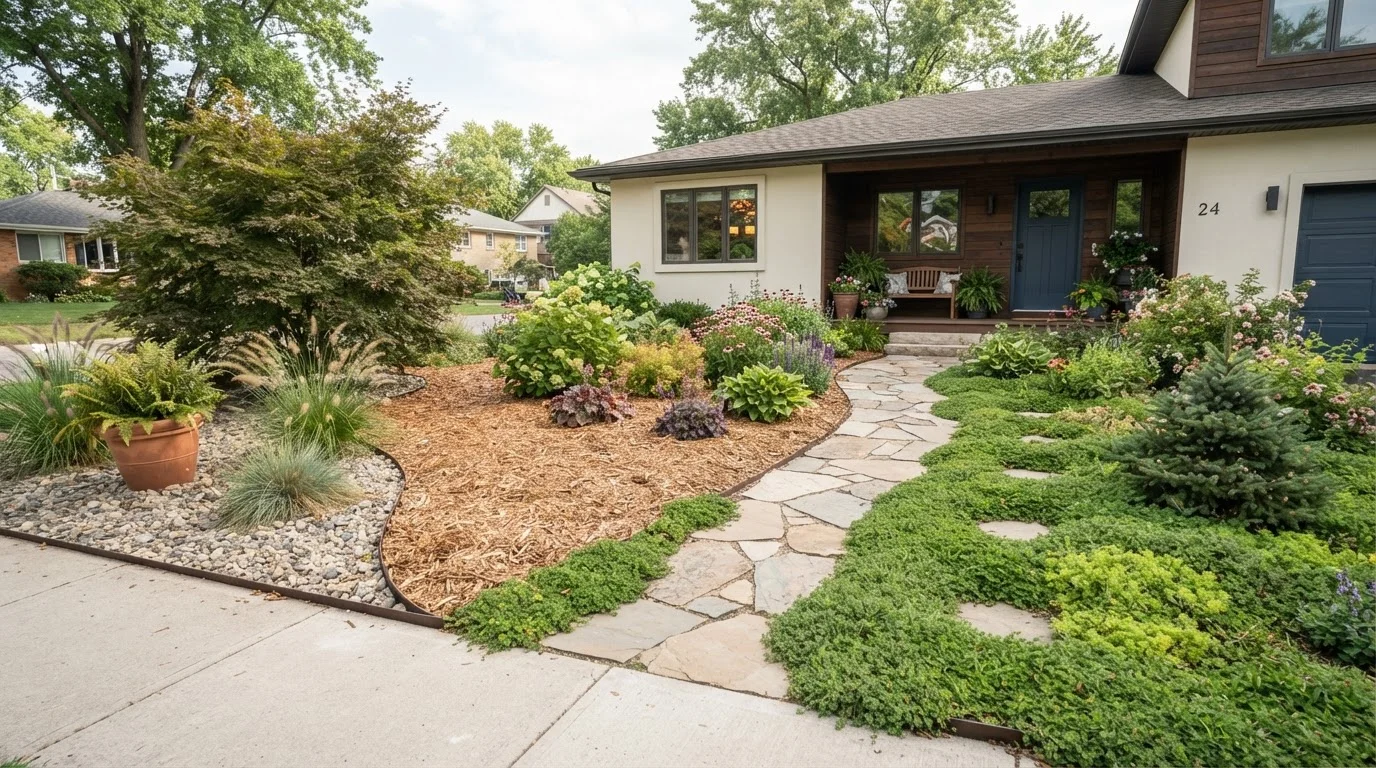
Most yards benefit from using more than one material. A practical approach is to match the material to the function of each zone. Gravel works well for pathways, side yards, and areas near the house foundation where drainage matters. Mulch fits planting beds and tree rings where soil improvement is the goal. Living ground covers suit sloped banks, shaded areas under trees, and spots where turf grass has repeatedly failed.
When combining materials, use physical edging to keep gravel and mulch separate, since they mix together over time and become difficult to manage. Landscape fabric under gravel helps control weeds but can degrade over several years, eventually requiring replacement.
Families with small patios or container gardens can extend the same logic to vertical or confined spaces. See our tips for container gardening on small patios for approaches that pair well with low-maintenance ground-level treatments.