

Key Takeaways
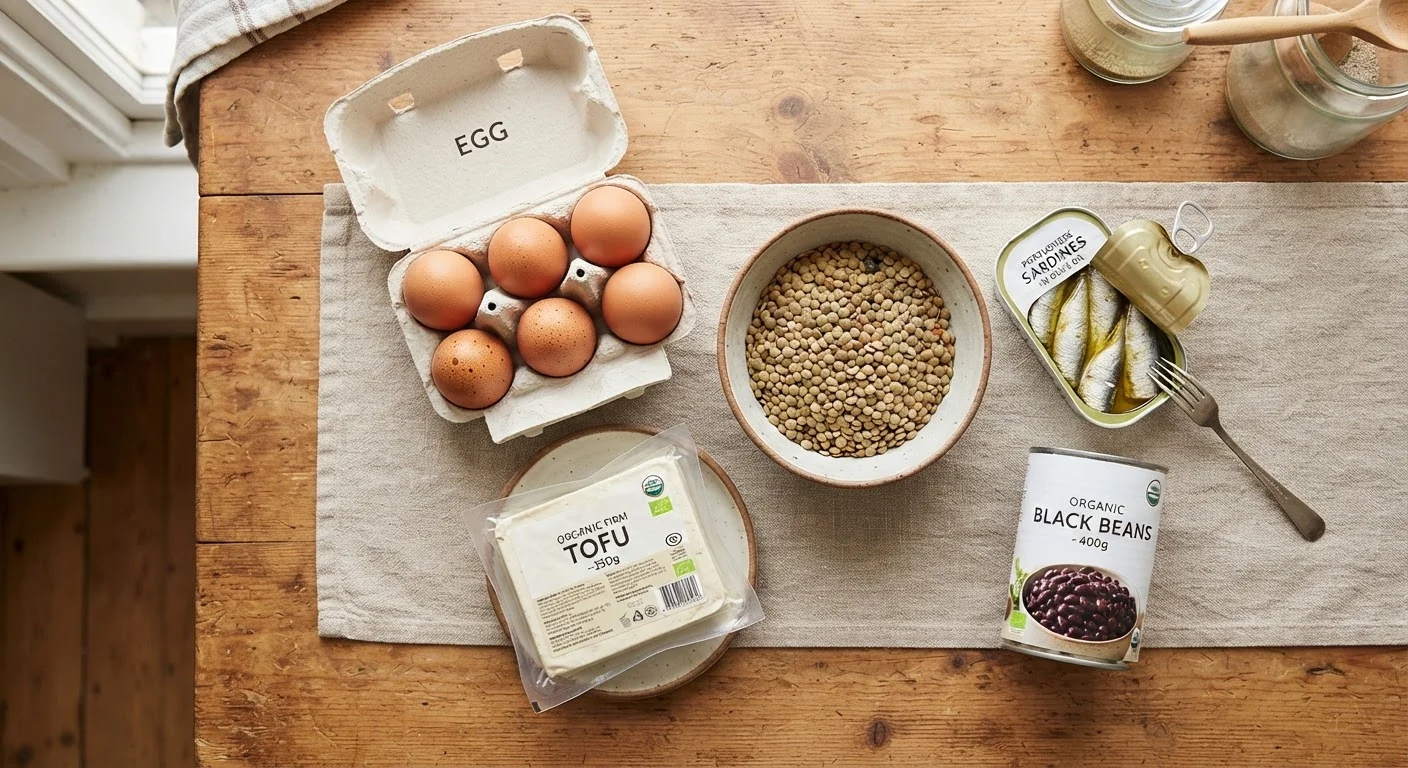
- Dried legumes deliver the lowest cost per gram of protein among common grocery staples.
- Eggs and canned fish offer strong protein value without requiring advance planning or soaking.
- Tofu costs more per gram than legumes but remains competitive compared to most animal proteins.
- Mixing protein sources across the week covers nutritional gaps while keeping spending in check.
- Cooking method and packaging form (dried vs. canned) both affect the final cost per gram.
Our Verdict
Dried legumes come out ahead on pure cost per gram, with eggs and canned fish close behind. Families who balance these three source types across the week can meet protein needs at a fraction of the cost of fresh meat. No single source is nutritionally complete on its own, so variety matters alongside price.
| Best for | Recommended |
|---|---|
| Families on the tightest grocery budgets | Dried lentils and dried beans |
| Quick weeknight meals with minimal prep | Eggs and canned fish |
| Plant-based or reduced-meat households | Tofu and canned legumes |
| Households balancing convenience and cost | Canned beans and eggs |
Why cost per gram matters more than sticker price
A package of chicken thighs looks affordable until you compare it against a bag of dried lentils by protein delivered per dollar spent. Sticker price alone misleads because protein density varies widely across foods. Cost per gram of protein is a more useful measure: it divides what you pay by how many grams of protein a serving actually contains.
The calculation is straightforward. Divide the price of a package by its total weight in grams, then divide again by the percentage of that weight that is protein. Even rough estimates let families spot where their protein dollars go furthest. This article applies that lens to six common sources: dried legumes, canned legumes, eggs, canned fish, tofu, and chicken thighs (included as a familiar reference point).
For context on building a full week of meals around affordable proteins, see the family nutrition on $100 a week guide.
How each protein source compares
The figures below are based on typical US grocery prices and standard USDA nutritional data. Prices shift by region and season, so treat these as order-of-magnitude comparisons rather than precise quotes.
| Dried legumes | Canned legumes | Eggs | Canned fish | Tofu | Chicken thighs | |
|---|---|---|---|---|---|---|
| Approx. cost per gram of protein | 1-2 cents | 3-4 cents | 3-4 cents | 3-6 cents | 5-8 cents | 6-9 cents |
| Prep time | 30-90 min (soak/cook) | 5 min (drain, heat) | 5-10 min | 2-5 min | 10-15 min | 25-45 min |
| Protein per serving | ~15g per cooked cup | ~7-9g per half cup | ~6g per egg | ~20-25g per can | ~8-10g per half cup | ~25-30g per thigh |
| Complete protein | No (combine grains) | No (combine grains) | Yes | Yes | Yes | Yes |
| Shelf stable | Yes (1+ years) | Yes (2+ years) | No (refrigerate) | Yes (2-5 years) | No (refrigerate) | No (freeze) |
| Notable nutrients beyond protein | Fiber, iron, folate | Fiber, iron, folate | B12, choline, D | Omega-3, B12, D | Calcium, iron | B12, zinc, iron |
Dried legumes (lentils, black beans, pinto beans) consistently land at or below 3 cents per gram of protein. A one-pound bag of dried lentils typically yields around 50 grams of protein per cooked cup and costs roughly $1.50 to $2.00, putting the cost well under 2 cents per gram when prepared. Canned vs. dried bean costs break down further if your family weighs convenience against savings.
Eggs run about 3 to 4 cents per gram of protein at average US prices. A dozen large eggs at $3.00 contains roughly 72 grams of protein total (6 grams per egg), which works out to just over 4 cents per gram. Eggs also supply vitamin B12 and choline, nutrients absent from plant proteins.
Canned fish (sardines, tuna, salmon) lands between 3 and 6 cents per gram depending on the variety. Sardines in water are typically the most cost-efficient, while canned salmon costs more per can but delivers omega-3 fatty acids alongside a strong protein yield.
Tofu averages 5 to 8 cents per gram of protein. Firm tofu typically contains 8 to 10 grams of protein per half-cup serving. The cost is higher than legumes, but tofu is a complete protein (it contains all essential amino acids) and cooks quickly without soaking.
Chicken thighs (bone-in, skin-on) run 6 to 9 cents per gram of protein at typical US supermarket prices, positioning them above most of the plant and egg options on a straight cost-per-gram basis. They remain a familiar, versatile option many families already cook regularly.
What the numbers miss
Cost per gram captures price efficiency but not the full nutritional picture. Animal proteins (eggs, fish, chicken) supply vitamin B12, which plant proteins do not. Legumes provide significant dietary fiber, which eggs and fish do not. Canned fish adds long-chain omega-3 fatty acids that most plant sources cannot match.
Bioavailability also varies. The protein in eggs is absorbed at a very high rate, while plant protein bioavailability is somewhat lower due to fiber and certain compounds in legumes. This does not make plant proteins inferior, but it does mean that families relying primarily on legumes benefit from eating a variety of them across the week rather than depending on a single type.
Stretch legumes further with batch cooking
Cook a large pot of dried lentils or beans on the weekend and divide portions into freezer bags. Frozen cooked legumes keep for up to three months and reheat in minutes. This removes the main practical barrier to using the lowest-cost protein sources on busy weeknights.
For families building a pantry around these sources, the pantry staples guide for balanced meals covers how to store and rotate stock efficiently.
This article is for general informational purposes only and is not medical or dietary advice. Consult a registered dietitian or qualified healthcare professional for guidance tailored to your family's specific health needs.
Practical ways to use this comparison
A family that anchors two or three dinners per week around dried beans or lentils, uses eggs for quick breakfasts and lunches, and adds canned fish once or twice a week can meet protein targets at a cost well below a meat-heavy meal plan. Tofu works well as a once-weekly addition, especially in stir-fries or soups where it absorbs surrounding flavors.
Batch cooking dried legumes on a weekend and portioning them into freezer bags removes the weeknight barrier that pushes many families toward pricier convenience proteins. A single two-hour batch of cooked black beans can cover four to five meals. See the meal planning framework for tight budgets for a week-by-week structure that incorporates these sources.
Pairing legumes with whole grains (rice, oats, corn tortillas) in the same meal improves the amino acid profile of plant-based protein. The whole grains on a budget explainer covers which grain options give families the most nutritional return per dollar.