

Key Takeaways
- Organic certification limits synthetic pesticide use but does not guarantee zero pesticide residue on produce.
- The price gap between organic and conventional food is real and can strain tight grocery budgets.
- The USDA's Pesticide Data Program annually ranks produce by residue levels, giving families a practical starting point.
- Washing conventional produce under running water reduces surface residue for most items.
- Seasonal and frozen organic options often cost less than year-round fresh organic alternatives.
Lower synthetic pesticide residue on produce
USDA testing consistently finds lower pesticide residue levels on certified organic fruits and vegetables compared to conventional counterparts, which is the primary documented health-related benefit.
No routine antibiotic use in organic livestock
Organic meat and dairy standards prohibit the routine use of antibiotics, which is relevant to concerns about antibiotic-resistant bacteria in the food supply.
May contain higher levels of certain antioxidants
Some research suggests organic crops can have modestly higher concentrations of certain polyphenols, possibly because plants produce more of these compounds under the stress of growing without synthetic protection.
Supports farming practices with lower environmental inputs
Organic certification restricts synthetic fertilizer runoff, which affects soil and waterway health over time, though the full environmental picture is more complex than a simple conventional-versus-organic comparison.
Consistently higher cost per item
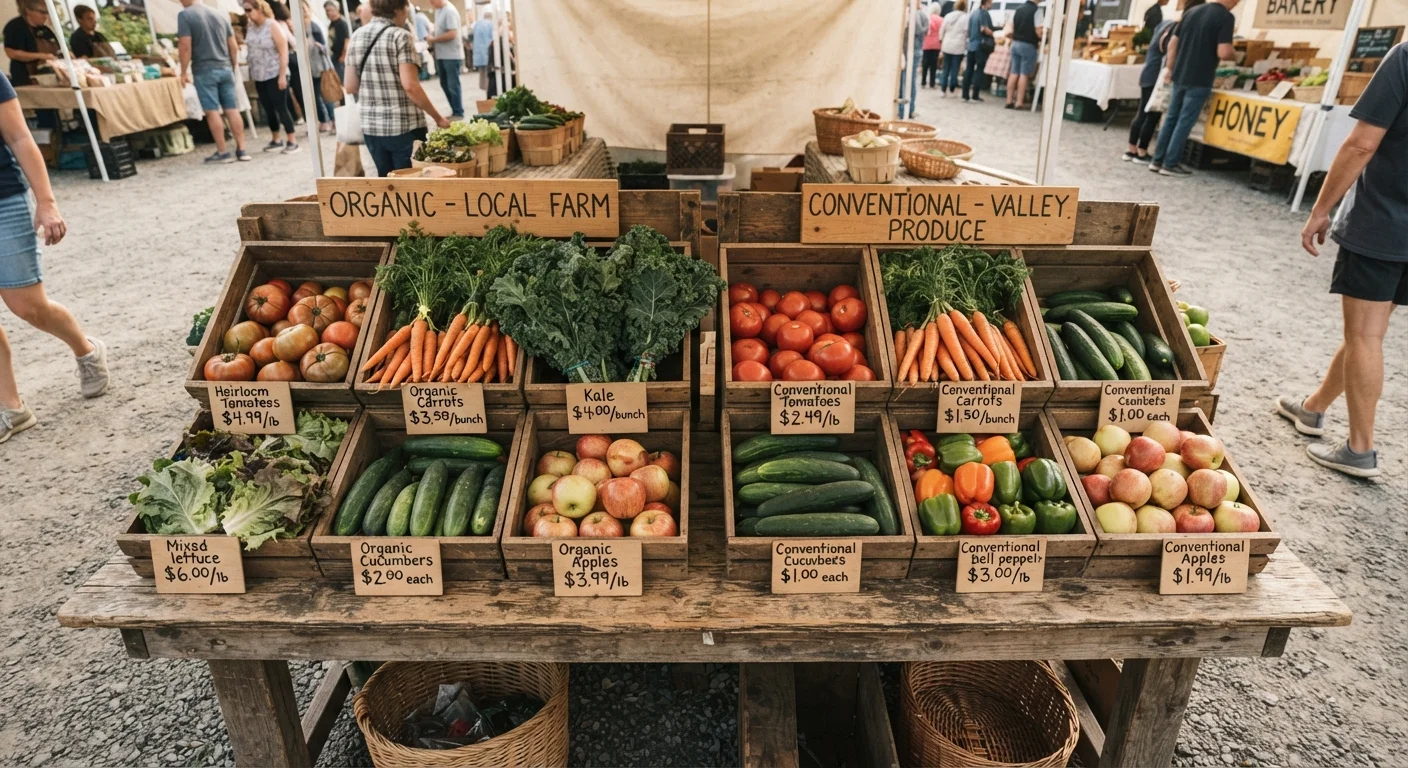
Organic produce and packaged goods typically cost 20% to 100% more than conventional equivalents, depending on the item and retailer. For families on tight budgets, this premium adds up quickly across a week of groceries.
No evidence of substantially superior nutrition
Large reviews of the research find that vitamin and mineral content in organic versus conventional produce is broadly similar. Families expecting a major nutritional upgrade may not see one.
Smaller selection and shorter shelf life
Organic options are not available for every produce type, and some items have a shorter shelf life because they are grown without certain post-harvest treatments, which can increase household food waste.
Organic label does not cover all food safety risks
Pathogens such as E. coli and Salmonella are not prevented by organic certification. Safe food handling, washing, and cooking temperatures remain necessary regardless of how produce was grown.
Spending more on organic can reduce overall food variety
A fixed grocery budget spent heavily on organic items leaves less room for a wide range of fruits, vegetables, and proteins. Dietary diversity is itself a strong predictor of good nutritional outcomes.
Our Verdict
Organic food offers a meaningful but limited nutritional edge, primarily around pesticide exposure rather than superior vitamin content. For budget-conscious families, a selective approach, prioritizing organic on high-residue produce while buying conventional for lower-risk items, gives the most practical return. Spending the whole grocery budget on organic at the expense of fruit and vegetable variety is not a trade-off that serves family health.
Families with a little budget flexibility who want to reduce pesticide exposure on specific produce items without overhauling their entire grocery routine.
What organic actually means at the store
The USDA organic label means food was produced without most synthetic pesticides, synthetic fertilizers, or genetically modified organisms. For livestock, it means animals had access to pasture and were not given antibiotics or growth hormones. What it does not mean is that no pesticide was used at all: approved natural substances can still be applied, and cross-contamination from neighboring farms can leave trace residues even on certified crops.
Understanding this distinction matters before weighing cost. Organic is a production standard, not a nutrient guarantee. The nutritional differences between organic and conventional produce are generally small and inconsistent across studies. The more documented difference is in pesticide residue levels, which tend to be lower on organic items.
Organic does not mean pesticide-free
The USDA organic program permits a list of approved natural substances for pest and disease control. Organic farms can also receive drift from neighboring conventional fields. Residue testing by the USDA Pesticide Data Program finds that organic produce tends to have lower residue levels and fewer distinct residues than conventional produce, but detectable residues do appear on a portion of organic samples. This distinction is worth keeping in mind when evaluating the premium.
The pros of buying organic
Lower synthetic pesticide residue on produce
USDA testing consistently finds lower pesticide residue levels on certified organic fruits and vegetables compared to conventional counterparts, which is the primary documented health-related benefit.
No routine antibiotic use in organic livestock
Organic meat and dairy standards prohibit the routine use of antibiotics, which is relevant to concerns about antibiotic-resistant bacteria in the food supply.
May contain higher levels of certain antioxidants
Some research suggests organic crops can have modestly higher concentrations of certain polyphenols, possibly because plants produce more of these compounds under the stress of growing without synthetic protection.
Supports farming practices with lower environmental inputs
Organic certification restricts synthetic fertilizer runoff, which affects soil and waterway health over time, though the full environmental picture is more complex than a simple conventional-versus-organic comparison.
For families who eat a lot of produce, the pesticide-residue argument carries the most weight. Children are more sensitive to pesticide exposure than adults because their organ systems are still developing, and they eat more food relative to their body weight. Choosing organic strategically on items that consistently show higher residue concentrations addresses this concern without requiring a full household switch.
The cons of buying organic
Consistently higher cost per item
Organic produce and packaged goods typically cost 20% to 100% more than conventional equivalents, depending on the item and retailer. For families on tight budgets, this premium adds up quickly across a week of groceries.
No evidence of substantially superior nutrition
Large reviews of the research find that vitamin and mineral content in organic versus conventional produce is broadly similar. Families expecting a major nutritional upgrade may not see one.
Smaller selection and shorter shelf life
Organic options are not available for every produce type, and some items have a shorter shelf life because they are grown without certain post-harvest treatments, which can increase household food waste.
Organic label does not cover all food safety risks
Pathogens such as E. coli and Salmonella are not prevented by organic certification. Safe food handling, washing, and cooking temperatures remain necessary regardless of how produce was grown.
Spending more on organic can reduce overall food variety
A fixed grocery budget spent heavily on organic items leaves less room for a wide range of fruits, vegetables, and proteins. Dietary diversity is itself a strong predictor of good nutritional outcomes.
The financial reality is that organic costs more, often substantially. A family stretching a weekly grocery budget may end up buying fewer total fruits and vegetables if they commit entirely to organic. Dietitians generally agree that eating more conventional produce is better for health than eating less organic produce. The nutritional case for frozen vegetables is also relevant here: frozen conventional produce is often more affordable and nutritionally comparable to fresh organic options.
A practical framework for families on a budget
The most evidence-grounded approach for budget families is selective purchasing. Each year, the USDA Pesticide Data Program publishes residue data by commodity. Advocacy groups use that data to produce widely circulated lists that rank produce by how often and at what levels pesticides appear. Strawberries, spinach, and peaches tend to appear near the top of high-residue lists; avocados, sweet corn, and pineapple tend to appear near the bottom.
Using this information, a family can prioritize organic spending on a short list of items, usually eight to twelve produce types, while buying conventional for the rest. Pairing this with seasonal produce planning can reduce costs further, since organic versions of in-season items are often priced closer to their conventional counterparts.
Washing all produce, organic or not, under running water before eating removes a meaningful share of surface residue and dirt. It does not eliminate systemic pesticides absorbed into the plant tissue, but it is a free, low-effort step with real benefit.
Building meals around affordable staples alongside selectively chosen organic items is a manageable middle path. The pantry staples that anchor balanced meals approach works well here: when the backbone of the diet is legumes, whole grains, and canned goods, the organic line-item stays small.
This article is for general informational purposes only and is not medical or dietary advice. Consult a qualified healthcare professional or registered dietitian for guidance specific to your family's health needs.