
Key Takeaways
- The 50/30/20 rule splits after-tax income into needs, wants, and savings or debt repayment.
- Zero-based budgeting assigns every dollar a purpose before the month begins, leaving no untracked money.
- Pay-yourself-first moves savings out before spending decisions are made, reducing the temptation to skip them.
- No single framework works for every household; income stability and spending patterns should guide your choice.
- Any framework needs periodic review as income, expenses, and family circumstances change.
Our Verdict
The 50/30/20 rule is a practical starting point for households new to budgeting because it is simple and forgiving. Zero-based budgeting suits those who want tight control over every category, while pay-yourself-first works well for people who struggle to save consistently. Envelope budgeting can help families that overspend in specific cash-driven categories.
| Best for | Recommended |
|---|---|
| Households new to budgeting who want a simple structure | 50/30/20 rule |
| Those who want granular control over every spending category | Zero-based budgeting |
| People who consistently fail to save before spending | Pay-yourself-first |
| Families prone to overspending in specific categories like groceries or dining | Envelope budgeting |
Why a budgeting framework matters
A framework does one thing well: it removes the need to make a new spending decision from scratch every month. Without one, most households drift, spending reactively and saving whatever happens to be left over (which is often nothing). A structured method gives every dollar a job before it arrives in your checking account.
None of these frameworks requires specialized software or financial expertise. They are general educational tools, not personalized financial advice. If your situation involves significant debt, irregular income, or complex tax considerations, a licensed financial professional can help you adapt any approach to your circumstances.
For families already thinking about how spending decisions connect to other areas of household life, frameworks like these can work alongside practical planning in categories such as groceries. See common budget meal planning mistakes to understand how tracking food spending fits into a broader budgeting habit.
The 50/30/20 rule
This framework, widely attributed to the concept popularized in personal finance education, divides after-tax (take-home) income into three broad buckets:
- 50% toward needs: housing, utilities, groceries, transportation to work, minimum debt payments, and similar non-negotiable expenses.
- 30% toward wants: dining out, subscriptions, entertainment, and other discretionary spending.
- 20% toward savings and additional debt repayment: an emergency fund, retirement contributions, and accelerated loan payoffs.
The main draw is simplicity. You do not need to track dozens of subcategories. If your needs consistently consume more than 50% of take-home pay, which is common in high-cost cities, the framework signals a structural problem worth addressing rather than a willpower issue.
The weakness is that 50/30/20 can be too coarse. A household carrying significant credit card debt may need to redirect well above 20% to debt repayment before building savings. The framework does not give clear guidance on sequencing. For a plain-language breakdown of how different debt types affect your financial picture, see types of household debt.
Zero-based budgeting
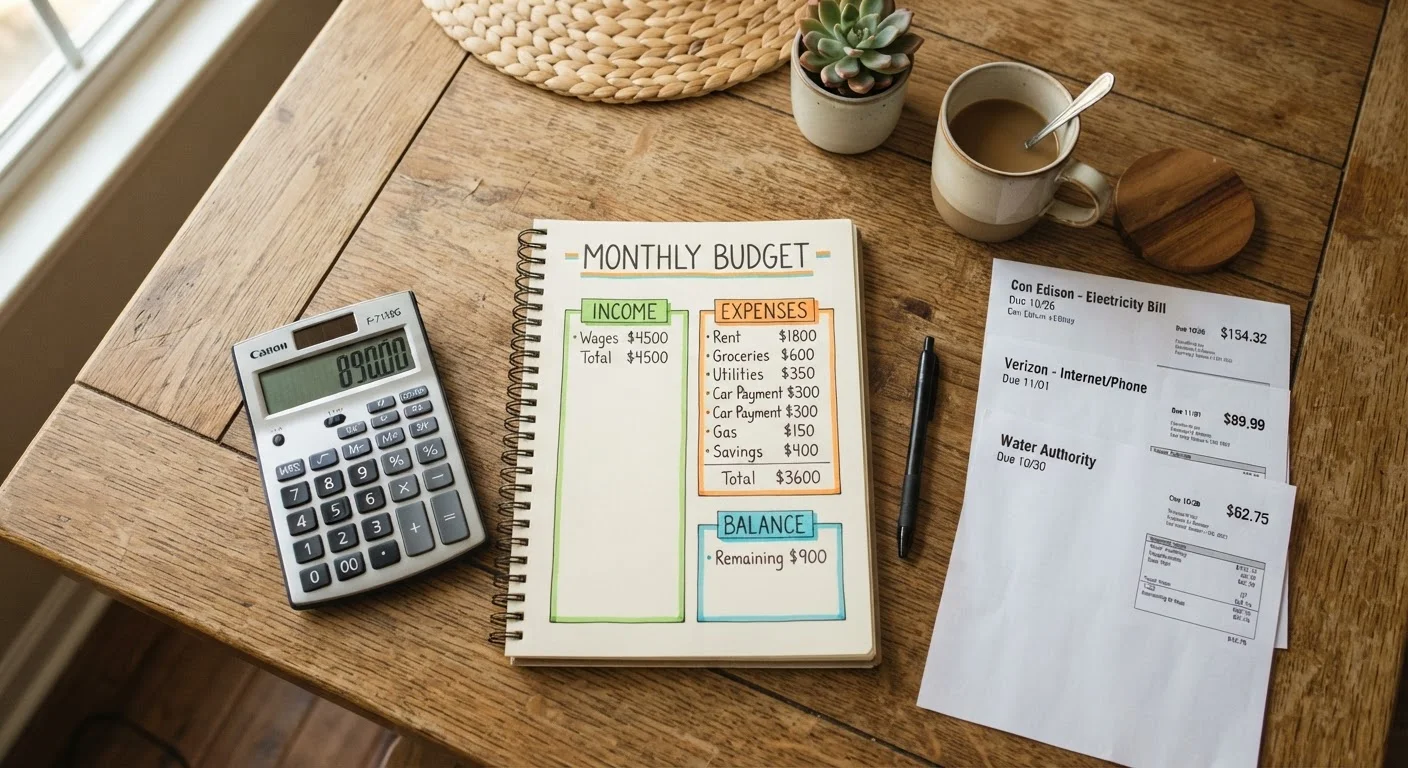
Zero-based budgeting starts with income and allocates every dollar to a named category until the balance reaches zero. "Zero" does not mean spending everything; savings and investment contributions are categories just like rent and groceries. The goal is that income minus all allocations equals zero, so no money is unaccounted for.
This method works well for households with variable spending patterns or those who have tried looser systems and still found themselves surprised at month-end. The discipline of naming each category forces awareness. The cost is time: zero-based budgeting typically requires weekly or even daily maintenance to stay accurate.
| 50/30/20 rule | Zero-based budgeting | Pay-yourself-first | Envelope budgeting | |
|---|---|---|---|---|
| Setup effort | Low | High | Low | Medium |
| Ongoing maintenance | Low | High | Very low | Medium |
| Works with variable income | Moderate | Harder to manage | Yes | Moderate |
| Savings discipline built in | Yes (20% target) | Yes (as a category) | Yes (automated) | Only if assigned |
| Best for overspending awareness | Broad only | Strong | Weak | Strong for chosen categories |
| Flexibility | High | Low | High | Low |
If you are building this habit alongside a savings goal, starting a savings habit on a tight budget covers practical steps for households where discretionary room is narrow.
Pay-yourself-first
Pay-yourself-first reverses the usual sequence. Instead of spending first and saving whatever remains, you move a fixed amount into savings or a retirement account the moment income arrives, then live on what is left.
The behavioral logic is straightforward: money that never appears in a spending account is rarely missed. Automating the transfer removes the decision entirely. The percentage you save is flexible, so this approach can work even when cash is tight. Starting at a small amount and increasing it gradually as income grows is a reasonable path.
The risk is that if the fixed savings transfer is set too high, it can cause shortfalls in bill payments. The framework works best when you have already mapped your fixed obligations so you know the floor your take-home pay must cover.
Automate the transfer immediately
Set up an automatic transfer to a separate savings account on the same day your paycheck lands. Even a small fixed amount builds the habit before spending decisions compete for that money. Increase the amount in small increments each time income rises, rather than waiting until a large raise makes a big jump feel comfortable.
Envelope budgeting
Envelope budgeting allocates cash into physical (or digital) envelopes, one per spending category. When an envelope is empty, spending in that category stops for the period. It was originally designed around physical cash but several apps now replicate the mechanic digitally.
This method suits families who overspend in particular areas such as groceries, gas, or dining out. The hard stop is more tangible than a spreadsheet number. The limitation is that it requires consistent upkeep and works less smoothly with automatic bill payments, which do not map naturally onto a cash envelope.
Families applying envelope logic to grocery spending often find it pairs well with structured meal planning. a week-by-week meal planning framework can help translate a grocery envelope amount into a realistic weekly plan.
Choosing the right fit
The framework that gets used consistently is the one that matters. Factors worth considering:
- Income regularity: salaried households find zero-based budgeting easier to set up than freelancers with variable monthly income, who may prefer percentage-based rules.
- Time available: zero-based budgeting demands more maintenance; 50/30/20 and pay-yourself-first are lower-effort once set up.
- Savings gaps: if an emergency fund does not exist yet, pay-yourself-first or an explicit 20% savings allocation should be a priority. how to size and store an emergency fund covers the mechanics of that step.
- Spending blind spots: if overspending is concentrated in a few categories, envelope budgeting or the granularity of zero-based tracking will surface it faster.
Any of these methods can also be combined. A household might use the 50/30/20 structure as a monthly target while applying envelope logic to two or three categories that historically run over. The frameworks are tools, not rules, and none of them guarantees specific financial outcomes.
This article is for general informational and educational purposes only. It does not constitute personalized financial advice. Please consult a qualified financial professional for guidance specific to your situation.