

Key Takeaways
- Home equity is the difference between what your home is worth and what you still owe on it.
- Two forces build equity: paying down your mortgage principal and property value increases.
- Early mortgage payments reduce principal slowly because more of each payment covers interest.
- Market downturns, second liens, and cash-out refinancing can all reduce equity.
- Borrowing against equity creates new debt secured by your home, which carries real risk.
- Consulting a licensed financial adviser before accessing equity is strongly recommended.
What home equity actually is
Home equity is the portion of your home's value that you own outright. Calculate it by subtracting your remaining mortgage balance from the current market value of your property. If your home is appraised at $350,000 and you owe $220,000, your equity is $130,000.
That figure is not cash sitting in an account. It is a paper asset, meaning it exists on paper and becomes real money only when you sell the home or borrow against it. Equity also fluctuates because property values change, sometimes significantly, without any action on your part.
For many American families, home equity becomes the largest single asset they hold over a lifetime. Understanding how it behaves helps you make more informed decisions about your home and your broader finances. This article is general financial information, not personalized financial advice. Consult a licensed financial professional before making decisions based on your equity position.
How equity builds over time
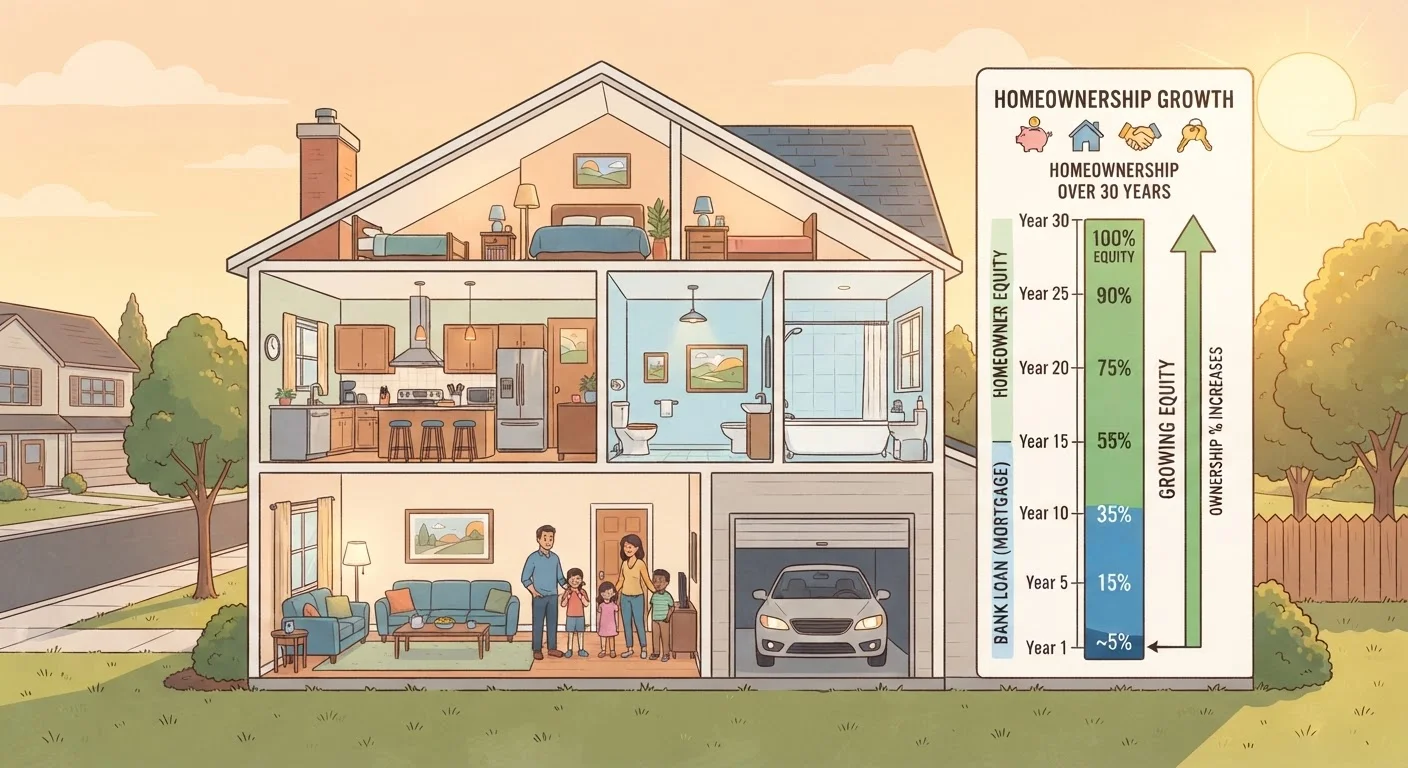
Equity grows through two main mechanisms: mortgage paydown and property appreciation.
Mortgage paydown
Every monthly mortgage payment contains two parts: principal (the loan balance itself) and interest (the cost of borrowing). Most standard mortgages are structured so that early payments are weighted heavily toward interest. This means equity builds slowly in the first several years, then accelerates as more of each payment chips away at the balance.
For example, on a 30-year fixed mortgage at a moderate interest rate, a homeowner might pay off less than 10 percent of the original principal in the first five years. By year 20, the pace accelerates considerably. This structure, called amortization, is worth understanding because it explains why selling or refinancing early often leaves less equity than homeowners expect.
Making extra principal payments when your budget allows can speed this process. Even small additional amounts applied to principal each month shorten the loan term and reduce total interest paid.
Property appreciation
When your home's market value rises, your equity rises by the same amount, independent of your mortgage paydown. A home that appreciates by $40,000 adds $40,000 to your equity without any payment from you.
Appreciation is driven by local market conditions, neighborhood demand, economic factors, and the condition of the property. Home improvements can contribute, though not all projects return their full cost in added value. General upkeep and curb appeal tend to protect value rather than generate large gains.
30 years
Standard fixed mortgage term in the U.S.
Most conventional home loans are structured over 30 years, with principal paydown accelerating in later years due to amortization.
Less than 10%
Principal typically paid off in first 5 years
On a standard amortizing mortgage, early payments are weighted toward interest, leaving the bulk of principal for later years.
2 ways
Primary mechanisms that build home equity
Mortgage principal paydown and property value appreciation are the two forces that increase a homeowner's equity position over time.
What can reduce your equity
Equity can fall, and several scenarios cause it to shrink.
- Property value declines: A softer real estate market reduces your home's appraised value, which directly lowers equity even if your loan balance stays the same.
- Cash-out refinancing: When you refinance and pull cash from your equity, your new mortgage balance rises, reducing what remains.
- Second liens: Home equity loans and home equity lines of credit (HELOCs) are additional debts secured by your home. They do not eliminate equity, but they reduce your net position.
- Deferred maintenance: A home in poor condition typically appraises lower, which erodes the value side of the equity equation.
Your home is collateral for any equity borrowing
Unlike unsecured debt such as a credit card, any loan secured by your home puts the property itself at risk if payments are not made. Foreclosure is a legal remedy available to lenders when a homeowner defaults on a secured loan. Before taking out a home equity loan or HELOC, evaluate whether you could maintain payments through a period of income disruption. Speak with a licensed financial adviser to assess your specific situation.
How families typically use home equity
Homeowners can access equity in several ways, each with different structures and risks.
Home equity loan
A home equity loan provides a lump sum at a fixed interest rate, repaid over a set term. It is a second mortgage, and your home serves as collateral. Missed payments can put your home at risk.
Home equity line of credit (HELOC)
A HELOC works more like a credit card with a borrowing limit tied to your equity. Interest rates are typically variable, meaning monthly payments can change. The draw period (when you can borrow) is usually followed by a repayment period.
Cash-out refinance
This replaces your existing mortgage with a larger loan, and you receive the difference in cash. Your monthly payment and loan term reset, which affects total interest paid over time.
Sale
Selling the home converts equity to cash after paying off the remaining mortgage, closing costs, and agent fees. This is the most direct way to realize equity as actual money.
Home equity connects to a household's broader debt picture. Understanding how a mortgage relates to other obligations is worth reviewing. See our plain-language guide to household debt types for context on how different debts interact.
Key questions to ask before tapping equity
Borrowing against your home creates a secured debt. If you cannot repay, foreclosure is a legal outcome. Before accessing equity, consider the following questions carefully.
- What is the total cost of borrowing, including interest over the full loan term, not just the monthly payment?
- Is the purpose a need (such as essential repairs) or a want? Using equity for discretionary spending increases risk without building long-term value.
- How stable is your income? A job loss or income disruption while carrying a second mortgage or HELOC increases the chance of default.
- What happens to your loan terms if interest rates rise, particularly with a variable-rate HELOC?
- Have you spoken with a licensed financial adviser about how this fits your overall financial plan?
Home equity is a genuine financial asset that grows with consistent mortgage payments and a well-maintained property. It is also illiquid and not without risk. Treating it as a slow-building resource rather than a quick source of cash generally produces better outcomes for families over time.
This article is for general informational purposes only and does not constitute financial, tax, or legal advice. Consult a licensed financial professional before making decisions about your home equity or any debt secured by your home.